


Blog > Moreland, Campbell, Cupertino, or San Jose? Understanding West San Jose's Overlapping Identities
Moreland, Campbell, Cupertino, or San Jose? Understanding West San Jose's Overlapping Identities
by
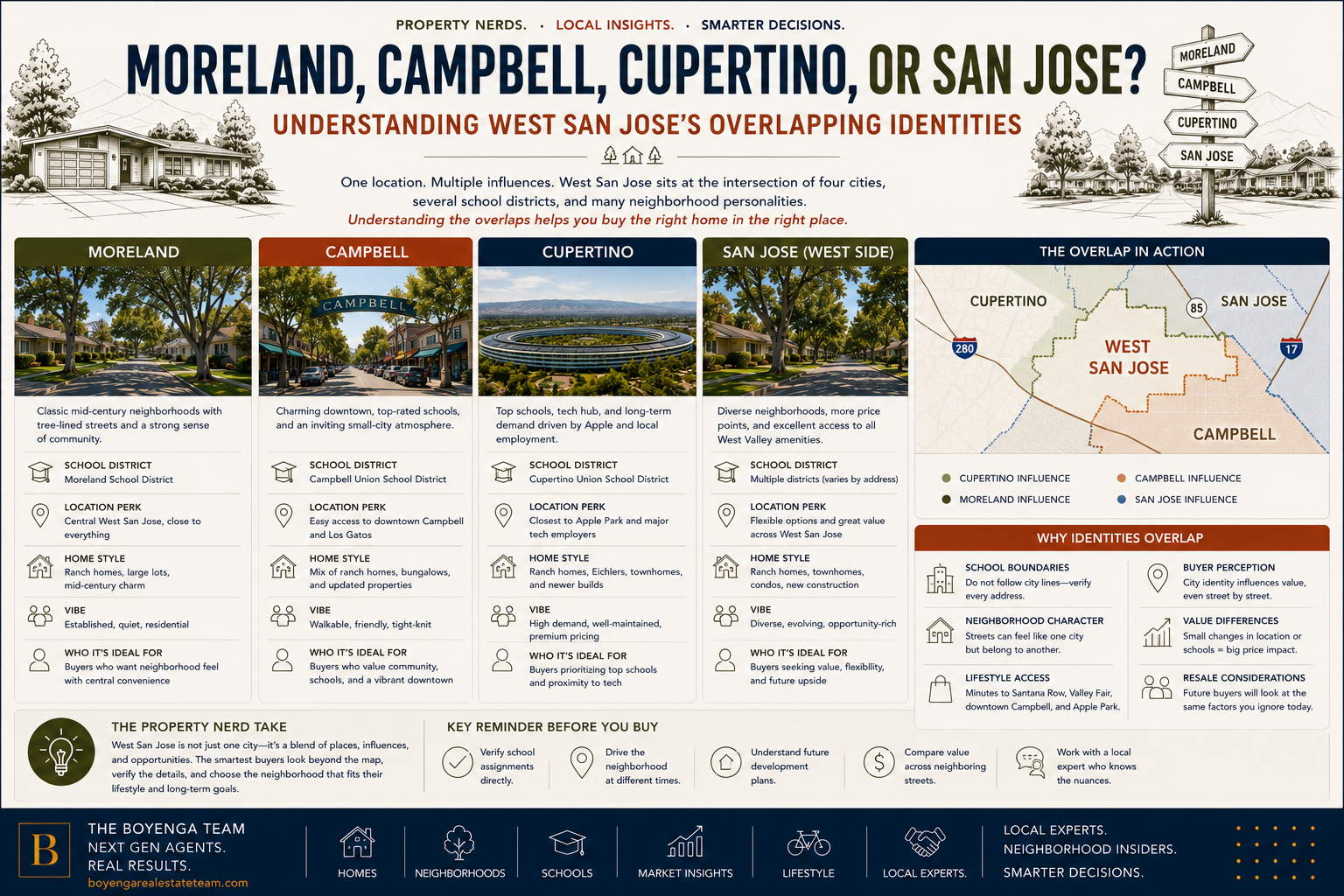 Few places in Silicon Valley create more confusion than West San Jose.
A buyer may have a San Jose mailing address, attend schools associated with Moreland or Campbell, shop in Cupertino, commute to Apple in minutes, and tell friends they live "near Santana Row." Every statement can be true at the same time.
Unlike many cities where municipal boundaries define a neighborhood's identity, West San Jose operates as a collection of overlapping influences. City limits, school districts, ZIP codes, neighborhood names, and buyer perception rarely align perfectly. Understanding how those layers interact helps buyers make more informed decisions—and often reveals opportunities that others overlook.
The Boyenga Team regularly explores these neighborhood dynamics through the Property Nerds Blog at https://www.boyengateam.com/blog, helping buyers look beyond city names to understand what truly drives value throughout Silicon Valley.
The first layer is the municipal boundary.
Most of West San Jose is, legally, part of the City of San Jose. Property taxes, city services, permitting, and local government all follow that designation. Yet buyers rarely evaluate the area based solely on municipal jurisdiction. Instead, they focus on the neighborhoods and institutions surrounding the home.
Schools often become the second identity.
A San Jose address may be served by the Moreland School District, Campbell Union School District, Cupertino Union School District, or San Jose Unified depending on the property's exact location. Those attendance boundaries frequently matter more to buyers than the city's name itself because they influence daily life, future buyer demand, and long-term resale potential. Two homes with identical San Jose addresses can compete in entirely different markets simply because of where children attend school.
The Boyenga Team's neighborhood guides at https://boyengarealestateteam.com regularly compare these overlapping school and neighborhood relationships, helping buyers understand why one block may command stronger demand than another despite sharing the same ZIP code.
Geography creates another layer of identity.
Residents may shop in Cupertino, dine at Santana Row, spend weekends in Campbell, commute through Santa Clara, and use parks or trails that extend across multiple jurisdictions. Daily routines rarely stop at city limits, which is one reason buyers often describe West San Jose by the places they frequent rather than the municipality printed on their driver's license.
Neighborhood character adds still another dimension.
Some parts of West San Jose feel closely connected to Cupertino because of nearby schools and technology employment. Others naturally relate to Campbell through walkability and community amenities. Neighborhoods near Santana Row carry a more urban energy, while ranch-home communities farther west emphasize mature landscaping, quiet residential streets, and larger lots. The result is a market where buyers often choose a lifestyle rather than a jurisdiction.
Architecture reinforces these differences.
West San Jose is known for its broad collection of classic California ranch homes, thoughtfully renovated mid-century properties, Eichlers in select neighborhoods, townhomes, and carefully integrated newer construction. Buyers interested in how architecture contributes to neighborhood identity can also explore https://midmodhomes.com, where California residential design is examined across many of Silicon Valley's most enduring communities.
Buyer perception frequently becomes the final—and perhaps most influential—layer.
Some buyers search exclusively for Cupertino. Others focus on Campbell or simply want to be near Santana Row. Many eventually discover that a West San Jose address delivers nearly identical access to the amenities they value while offering more home, a larger lot, or greater renovation potential for the same budget. That realization often shifts the search from city names to individual neighborhoods.
The overlapping identities also contribute to long-term market resilience.
Rather than depending on a single employer, one school district, or one downtown, West San Jose benefits from proximity to many of Silicon Valley's strongest economic and lifestyle centers. Buyers drawn by Apple may arrive for the commute. Others come for schools, shopping, neighborhood character, or architectural appeal. Together, those overlapping sources of demand create one of the broadest buyer pools in the region.
Ultimately, the smartest buyers stop asking, "Which city is this?"
They begin asking better questions.
Which schools serve the home? Which neighborhood does it feel connected to? Where do daily errands happen? How does the commute work? What kind of buyer will want this property ten years from now?
Those answers reveal far more about long-term value than the municipal boundary alone.
For buyers interested in architecturally significant neighborhoods throughout Silicon Valley—including Eichler communities and other thoughtfully planned California developments—https://bayareaeichlerhomes.com provides additional perspective on how neighborhood planning, architecture, and community identity continue shaping long-term housing demand.
The Property Nerd Take
West San Jose isn't defined by a single identity—that's exactly what makes it valuable. It sits at the intersection of multiple school districts, neighboring cities, employment centers, and lifestyle destinations. Buyers who understand those overlapping influences often discover opportunities that buyers focused only on city names never see.